My Mitsubishi Mini Split Is Not Cooling in Los Angeles
Mitsubishi mini split not cooling in Los Angeles? MSZ, MXZ, MUZ error codes and fault guide. Same-day diagnosis and repair from C-20 licensed technicians.
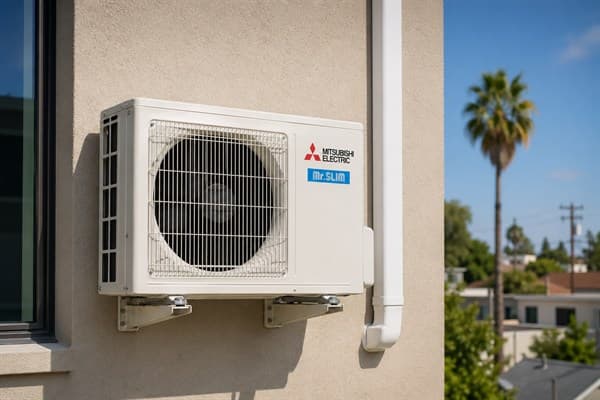
Mitsubishi equipment is installed across thousands of Los Angeles homes. Performance and longevity depend on installation quality, annual maintenance, and how well the system was sized for the home's actual heat load. Below are the specific issues we see most often on Mitsubishi service calls in Los Angeles.
Mitsubishi Electric is the leading mini split brand in Los Angeles, with a dominant share of the ductless market across residential and light commercial applications. The Mr. Slim and Diamond series systems installed in Hollywood apartments, Venice ADUs, Silver Lake historic homes, and Beverly Hills multi-zone estates all share the same underlying architecture — but each product line has specific failure modes and diagnostic patterns.
Why Mitsubishi Mini Splits Stop Cooling in Los Angeles
Dirty Indoor Head Filters
The single most common reason a Mitsubishi mini split loses cooling capacity. The indoor head (wall-mounted, ceiling cassette, floor-mounted) draws room air through a mesh filter. When that filter clogs — with pet hair, dust, cooking grease in kitchens — airflow through the evaporator coil drops dramatically.
The result: the coil gets too cold, freezes over, and the system either trips into a freeze protection mode (reduced airflow, warm air output) or locks out completely. The fix is simple — filter cleaning — but many LA homeowners don't know the filters exist or how to access them.
How to clean Mitsubishi filters:
- Lift the front panel of the indoor head upward until it locks in the open position
- Slide both mesh filters downward and out of their slots
- Rinse under cool water, gently brushing both surfaces
- Air dry completely (wet filters reinstalled immediately can introduce mold)
- Reinstall and lower the front panel
Low Refrigerant — Mitsubishi's Precise Factory Charge
Mitsubishi mini splits are charged with R-410A refrigerant to precise specifications. Unlike older residential systems with some tolerance for off-spec charge, Mitsubishi variable-speed inverter compressors are sensitive to refrigerant charge accuracy. A system low by even 10% of design charge shows measurable cooling capacity loss.
All refrigerant deficits indicate a leak. Common leak locations on LA mini split installations:
- Flare connections at the wall penetration where line set meets the indoor head — the most common leak point, particularly on systems installed quickly during the construction boom
- Flare connections at the outdoor unit — same issue
- Line set damage — physical damage from landscaping, construction, or animal activity on the exposed portion of copper line between indoor and outdoor units
- Valve core leaks at service ports on the outdoor unit
Refrigerant leak diagnosis and repair on Mitsubishi systems requires electronic leak detection followed by pressure testing — nitrogen pressure test confirms repair before refrigerant is added.
Error Code Lockout — Reading the Blink Patterns
Mitsubishi systems communicate faults through LED blink patterns on the indoor head and error codes on the wireless remote. Understanding these codes prevents unnecessary service calls and speeds up diagnosis:
| Error Code | Fault | Common Cause | |---|---|---| | E1 | Indoor/outdoor communication error | Faulty communication wire, blown fuse | | E6 | Communication fault | Same as E1 — control board or wiring | | E8 | Input current error | Power supply issue | | P1 | Intake sensor fault | Temperature sensor failure | | P4 | Drain full or blocked | Clogged condensate drain | | P6 / P8 | Freeze protection active | Dirty filters, low refrigerant | | U0 | Refrigerant shortage | Low charge — leak present | | U2 | High pressure abnormality | Dirty outdoor coil, outdoor fan failure | | U4 | Communication error | Outdoor control board or wiring |
When the remote displays an error code, write it down before calling — it speeds up the service call significantly.
Outdoor Unit Fan Motor Failure
The outdoor unit fan draws air through the condenser coil to reject heat. Fan motor failures on Mitsubishi outdoor units typically appear as:
- The outdoor unit runs and hums (compressor audible) but the fan blade isn't spinning
- High-pressure fault code (U2) appears shortly after startup
- System runs briefly then shuts down repeatedly
Mitsubishi fan motors are DC brushless motors controlled by the inverter board. They fail differently than AC motors on conventional systems — the symptoms can be confused with inverter board faults. A qualified technician tests both components before recommending replacement.
Fan motor replacement on Mitsubishi outdoor units runs $350–$700 for parts and labor. It's a same-day repair when the part is available.
Inverter Board Faults
The inverter board controls the variable-speed compressor and fan on Mitsubishi outdoor units. It's the most expensive component to replace ($600–$1,200 for parts alone on most models) and the one that requires genuine Mitsubishi-trained diagnosis to identify correctly.
Common inverter board failure symptoms:
- System attempts to start, compressor makes brief grinding or clicking noise, then shuts down
- Specific error codes pointing to inverter or compressor circuit faults
- System works intermittently — starts fine in the morning, fails by afternoon during heat
Inverter board failures are more common on systems that have experienced voltage spikes or sustained high ambient temperatures. Valley locations see higher rates of inverter board failures due to the sustained heat load on outdoor units.
Drain Line Blockage
Mitsubishi mini splits generate condensate water during cooling operation. This water drains through a small drain line (typically 3/4" PVC or flexible tubing) to a drain point — either gravity to an exterior location, or via a condensate pump to a drain. When this line clogs:
- Float switch in the indoor head trips, causing the system to display P4 error or shut down
- Water drips from the indoor head or through the wall penetration
- Musty odor from standing water in the drain pan
Drain clearing is a simple repair ($100–$200) but neglected drains eventually cause water damage to walls, ceilings, and flooring.
Mitsubishi Product Line: What System Do You Have?
Mr. Slim MSZ Series (Single-Zone Wall-Mounted)
The most common Mitsubishi mini split in Los Angeles. Single indoor head connected to a single outdoor unit (MUZ series). Available in sizes from 6,000 BTU to 36,000 BTU.
- MSZ-GL series: Entry-level Mr. Slim. Standard inverter compressor. Most repairs involve capacitors, fan motors, or refrigerant leaks. Parts widely available.
- MSZ-GS series: Mid-range. Similar architecture to GL, slightly more efficient.
- MSZ-FH series: Premium single-zone. Hyper-Heating technology (effective to -13°F ambient). More complex control boards.
Diamond MXZ Series (Multi-Zone)
Multi-zone outdoor units serving 2–8 indoor heads. Common in multi-room Los Angeles applications: Beverly Hills multi-zone, Hollywood apartment coverage, Silver Lake whole-house systems.
- MXZ-2C / 3C / 4C / 5C: Standard multi-zone outdoor units
- MXZ-SM series: City Multi-derived technology for larger multi-zone residential applications
Multi-zone diagnostics are more complex because one failing indoor head can affect the entire system. Identifying which zone caused the fault requires zone-by-zone elimination testing.
Hyper-Heating INVERTER (H2i) Systems
The MSZ-FH and MSZ-FS series are rated to heat down to -13°F ambient — relevant for Pasadena, San Gabriel Valley, and Foothill area homes where winter temperatures occasionally challenge standard heat pump limits. In cooling mode, these systems operate identically to standard units.
City Multi PUMY / PURY Series (Commercial)
Found in DTLA high-rises, commercial spaces, and larger residential applications. Service on City Multi systems requires Mitsubishi Diamond Dealer certification. We service both residential and light commercial Mitsubishi systems.
Mitsubishi vs. Other Mini Split Brands
| | Mitsubishi Electric | Daikin | LG | Samsung | |---|---|---|---|---| | Reliability in LA | Excellent | Excellent | Good | Good | | Parts availability | Excellent | Good | Fair | Fair | | Repair technician availability | Wide | Moderate | Limited | Limited | | Entry price point | Moderate | Moderate | Lower | Lower | | Warranty | 5-yr parts / 7-yr compressor | 5-yr parts | 5-yr parts | 5-yr parts |
The parts and technician availability advantage for Mitsubishi is significant in Los Angeles. Less-common brands can have 2–4 week lead times on parts; Mitsubishi parts are typically available same-day or next-day through LA distributors.
Mitsubishi Maintenance Schedule for Los Angeles
| Task | Frequency | DIY or Pro | |---|---|---| | Filter cleaning | Every 2–4 weeks (cooling season) | DIY | | Drain line check | Seasonally | DIY | | Coil cleaning (indoor) | Annually | Pro | | Outdoor coil cleaning | Annually (biannually in Valley) | Pro | | Refrigerant check | Every 3–4 years | Pro | | Full system diagnostic | Annually | Pro |
Mitsubishi equipment is durable. Systems that receive annual maintenance routinely reach 15–20 years of service life in Los Angeles conditions. Neglected systems — particularly those with chronically dirty filters — fail well short of that.
Frequently Asked Questions
Related Pages
Get a Free Estimate Today
Talk to a licensed C-20 technician — no pressure, honest answers.