AC Repair in Los Angeles
AC repair in Los Angeles from C-20 licensed technicians. Same-day diagnosis, flat-rate pricing, and most repairs completed on the first visit.
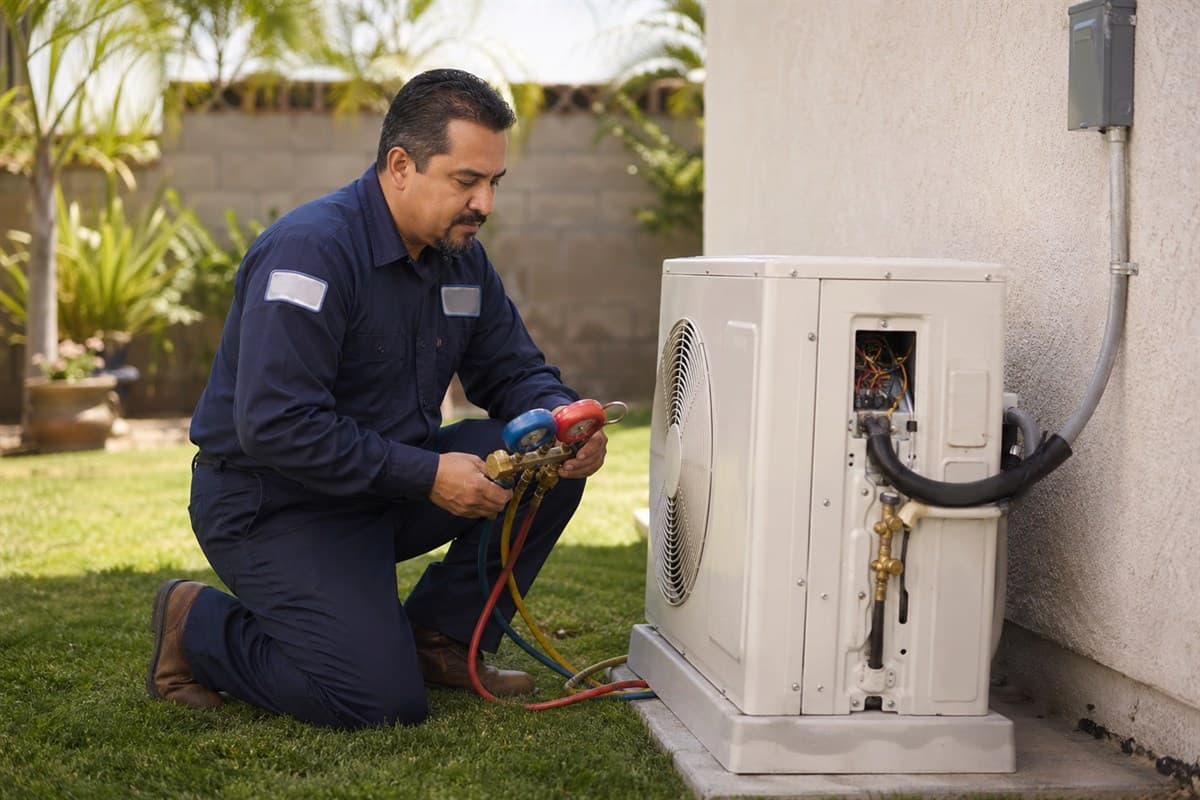
What Our Technicians Check First
- Air filter condition — clogged filters cause the most common LA cooling failures
- Thermostat settings and calibration — rules out 10–15% of no-cooling calls before touching anything
- Circuit breakers and disconnect switches — tripped breakers on outdoor units are common after LA power fluctuations
- Refrigerant pressure (high and low side) — indicates charge level and compressor health
- Condenser coil condition — LA smog and dust clog condenser fins within one season
- Capacitor voltage — most common single-point electrical failure in LA summer heat; tests in 60 seconds
Why Choose Us
- C-20 licensed and insured
- Local technicians with Los Angeles experience
- Flat-rate pricing — no surprise charges
- Same-day service across LA County
Our Process
- You call — we answer 24/7
- Tech dispatched, ETA confirmed by text
- Full diagnosis and flat-rate quote
- Repair completed same day where possible
- Follow-up to confirm system is running well
AC repair in Los Angeles means something specific: a long cooling season that runs May through October, Valley heat that regularly pushes past 105°F, and a housing stock where a significant share of systems are 12–20 years old. The difference between a repair call and a replacement call often comes down to which component failed and how long the system has been running degraded. Most failures are diagnosable in 30 minutes and fixable the same day.
Common AC Repair Calls We Get in Los Angeles
Capacitor failure is the most frequent service call in the Valley. Capacitors are the start and run components for your compressor and fan motors — when they fail, the outdoor unit hums but won't start. LA's summer heat shortens capacitor life to 6–8 years versus 12 or more in milder climates. A capacitor replacement is one of the fastest repairs on the truck: the part costs $25–$60, the labor is straightforward, and the system is usually running again within the hour.
Refrigerant leaks are more involved. Pre-2010 homes often have R-22 systems — a refrigerant now phased out under federal regulation, making any repair more expensive. Newer systems using R-410A commonly develop leaks at flare fittings, valve cores, and evaporator coil connections. A refrigerant leak repair involves finding the leak with an electronic detector, repairing the breach, pressure-testing, evacuating the system, and recharging to manufacturer spec. A top-off without a leak search is not a repair — it is a delay.
Dirty condenser coils are a maintenance failure that turns into a repair call. Los Angeles smog, particulate, and cottonwood deposits block the outdoor coil's ability to reject heat. The system runs longer, works harder, and eventually trips on high-head pressure. Annual coil cleaning is not optional in LA — it is the difference between a system that runs 15 years and one that fails at 9.
Blower motor failure is frequently misdiagnosed as compressor failure. The outdoor unit keeps running, but there is no airflow from the vents because the indoor fan has stopped. The system then freezes up and shuts down. The repair is a motor replacement — significantly less expensive than a compressor job. Always confirm airflow from every vent before assuming the worst.
Thermostat and control board issues account for a meaningful share of no-cooling calls, particularly on communicating systems like Carrier Infinity and Lennox iComfort. These systems communicate fault codes through the thermostat display — a technician who knows how to read them can often skip an hour of manual diagnosis and go straight to the failed component.
For Goodman systems, the most common failure points are the capacitor, contactor, and control board — all of which are straightforward repairs when caught early.
Repair vs Replace — The Los Angeles Calculation
Systems under 10 years: Repair almost always makes sense. A well-installed system at this age has meaningful life remaining, and a single component failure does not indicate general decline.
10 to 14 years: Apply the 50% rule. If the repair quote exceeds 50% of the cost of a new system of equivalent capacity, get both quotes and compare. Efficiency gains from a new high-SEER system, current utility rebates, and the refrigerant transition may shift the math toward replacement — but not always.
Over 15 years: New system economics often win, particularly with current rebates and the industry's shift away from R-410A toward R-454B. A 15-year-old system running at a fraction of its rated SEER will cost significantly more to operate than a modern replacement, independent of the repair itself.
R-22 systems specifically: The combination of leak repair labor, R-22 refrigerant pricing (often $50–$150 per pound due to phase-out), and the limited remaining life of aging components frequently makes replacement the better math. A licensed technician will give you both numbers before any work begins.
What a Repair Visit Looks Like
A technician arrives in a marked service vehicle with a stocked van covering the most common repair parts — capacitors, contactors, motors, hard-start kits, and refrigerant for both R-22 and R-410A systems.
The diagnostic covers all major systems: electrical measurements on the capacitor, contactor, and control board; refrigerant pressure on both high and low sides; compressor amp draw against rated specifications; airflow measurement at supply and return; and a full visual inspection of the indoor and outdoor units.
You receive a written flat-rate quote after diagnosis and before any work begins. No hourly billing, no scope that expands after the work starts. Most repairs are completed on the same visit. If a part needs to be sourced — a specific ECM motor or OEM control board — the technician gives you a realistic timeline and recommends a temporary measure where one exists.
After the repair, the system is run through a full test cycle: temperature split measurement, pressure verification, and confirmed operation at setpoint before the technician leaves.
Frequently Asked Questions
Related Pages
Service Areas
We service all of Los Angeles County, with dedicated coverage for these neighborhoods:
Get a Free Estimate Today
Talk to a licensed C-20 technician — no pressure, honest answers.